Thursday, 1 May 2014

Beijing Part 1 - Luxury Backpacking

Casey writes:

Beijing is a city of 18 million people. It's polluted, crowded and manic, but it has a certain charm about it that I can't quite place. When we are not standing in winding queues, dodging crazy vehicles on highways or being elbowed out of the way on the subway trains, we are playing hopscotch with the globs of saliva being hucked up and spat onto the footpaths by every second person who walks by.

The last time I was here, I regretted not having enough time to visit many of the tourist attractions in the city and beyond. This time however, we have both made up for lost time. We are staying in the Beijing City Central Youth Hostel, which has the marketing line, 'A budget hotel for businessmen and a luxury hostel for backpackers'. Now, we've stayed in many hotels already on this trip, and so I feel I am in a position to offer comment, and I must say, this is definitely not my favourite place to stay, nor does it feel particularly luxurious: the wifi doesn't work, the shared bathroom is dirty and many toilets are broken, the walls are paper thin, and there is more padding on the floorboards than on my mattress. Richard is still traumatised by the Chinese man who climbed up and peered into cubicle while he was in the shower, and who then yelled obscenities in Mandarin before disappearing. So while, I can't confirm its 'luxury' status, I can say that this hotel is cheap, is in a good location, and is more than sufficient for our needs given the small amount of time we actually spend there.

On our first morning in Beijing, we were out the door at 6:29am, on our way to queue for the Chairman Mao Mausoleum at Tian'anmen Square. We arrived at 7:00am, and although the doors didn't open until 8:00am, we found ourselves at the end of a snaking and windy queue of several thousand Chinese people, many of whom felt they deserved better than to wait, and spent their time shoving people out of the way so that they could get closer to the front. We got many weird looks, but we thoroughly enjoyed the two hour shuffle around and around the square until we finally arrived at the memorial hall. Once through security, there was pandemonium; a Chinese free for all, and the faster you could run, with the higher you held your elbows, the better position you could get yourself into. Once we entered the hall, it took all of thirty seconds to be herded past the peacefully sleeping (and eerily waxy looking) corpse of the great leader. We emerged into the sunlight, blinking, shaking off the souvenir vendors, and trying to work out what had just happened and why thousands upon thousands of Chinese tourists make this pilgrimage each day. We shrugged our shoulders and headed back to the hostel.


With our Lonely Planet guide in hand, we soon found ourselves in Beijing's Hutongs, a community of twisting alleyways, built after the destruction of the city by Kublai Khan's forces in the 1300s. We did a self-guided walking tour and found ourselves in some tiny lanes and intricate backstreets, watching the daily life activities of the local Han people who still live there.


Our food experiences in Beijing have been hit and miss:

Miss: On the first night we found no alternative but a small plate of dumplings and then made the obligatory trip to McDonalds when our stomachs were still rumbling.

Hit: Eating Peking Duck in a lovely restaurant where we could watch the chef preparing our food amidst the many duck carcasses hanging on hooks around him.

Miss: Trying to order pork buns for breakfast from a pork bun fast food restaurant, and resorting to taking a photo of the huge pork bun on the shop window to compensate our lack of Mandarin when the waitress gave us a bewildered look.

Hit: The pork belly burger and chips at the Great Leap Brewery. This place is run by an American, has English speaking barmen, a huge expat patronage, and soccer on the television. Needless to say we found ourselves there three nights in a row (although Richard will tell you that it was the soccer rather than the locally brewed beer that was the attraction).

Feeling lazy, and a little anxious of the thought of navigating public transport to three major world heritage sites, we took the easy option, and joined a day tour which visited the Temple of Heaven, the Forbidden City and the Summer Palace. It didn't matter that we had both seen some of these sites before, as we felt incredibly lucky to have the opportunity to experience them twice.

 The Temple of Heaven was peaceful and chaotic at the same time. Built in 1420, and originally the site of the emperor's prayers for good annual harvests, it is now a busy tourist attraction set in a pretty park, where middle aged locals play badminton and chess, dance, do tai chi, practise Peking Opera, and other physical and social endeavours.


The Forbidden City felt like all 18 million Beijing citizens decided to visit it on the same day. We shuffled along in monstrous crowds, through gate after gate, much like I remember doing years ago. Its sheer size is its attraction, and it has apparently 9,999 rooms (many of which are not available to the public).


The Summer Palace was the place I was most excited about. Again, its size is its drawcard, but the parks and gardens are equally awe-inspiring. We were herded through the crowds along the 700m 'Long Corridor' in record time, and found ourselves boarding a dragonboat for the trip across Kunming Lake back to the entrance.


The day tour as a whole was good, but we found that our activities definitely didn't reflect the advertised itinerary (what did we expect by booking through our 'luxury' hostel?). Instead of two hours at each main site, we were rushed through the three places in around 40 minutes each, and the rest of our day was spent being dragged around shopping sites, with hard working salespeople desperately trying to help us part with our money. The Chinese Medicine Clinic, Pearl Factory and Tearooms were all interesting, but it was sad to think we spent more time at these places than the places we'd paid to see. Unfortunately the Chinese tour companies see this as perfectly acceptable, so any complaints would have been in vain.

We planned to take it easy on our final full day in Beijing, Instead, we were on a bus by 9:00am, on our way to the World Heritage Listed Ming Tombs. We visited the Chang Ling tomb, which is the resting place of Emperor Yongle, his wife, and sixteen concubines. He was emperor from 1402-1424, and his Hall of Eminent Favours is now a museum housing many relics excavated from another nearby tomb called Ding Ling. The site was indeed quite grand.

Finally, with our last bit of energy, we visited the National Museum of China. Again, we queued up with the masses, and finally made it into this huge museum. Despite hearing excellent reviews, we were unimpressed, until we came across one particular exhibit. It housed all of the gifts that China had received (since Mao's rule) from foreign countries on world leaders' visits. And it was brilliant. From the exquisite to the downright tacky, we saw an array of absolutely bizarre objects. I am not sure what Mao would have done with a vase from Tajikistan, or a wooden elephant from Kenya, or a silver kangaroo from Australia, but they were all fascinating, and we marvelled at some of the clever ideas, and raised our eyebrows at many others.


After a month in China, we have learnt so much about the history, customs and culture of this country, and we've loved it more than we ever thought we would. We'll be back in Beijing in just under a week for one final hurrah, but in the meantime, we are counting down the minutes until we enter the next phase of our journey: North Korea. We can't even begin to predict what the next week has in store for us!
Arching Blue Skies and Endless Grasslands

Casey writes:

I have to admit, that after our experience of Baotou, and the superstar status our pale skin brought us while we were there, I boarded the train to Hohhot with some apprehension. I wasn't sure I could cope with another city of open-mouthed oggling.

But I needn't have worried. We became normal citizens again as soon as we set foot in Hohhot, which was immediately apparent as a progressive, attractive and friendly city. We were no longer being gawked at, and the pretty gardens and tree-lined streets allowed me to finally relax.

Hohhot. It looks easy enough to pronounce, doesn't it? In China, when a word has two syllables, it always has two equivalent Chinese characters (three syllables equals three characters, etc). So, we were perplexed when our train tickets showed four Chinese characters. Were we on the wrong train? Were we heading in the wrong direction? No, in fact, Hohhot is pronounced with four syllables: 'Hu-He-Hao-Te'. And its meaning is even more intricate: 'Arching blue skies over the grasslands'. Just another complexity of the Chinese language that we need to get our heads around.

Upon arrival at the train station, we were picked up by one of the workers at the Anda Hostel. This was a beautiful place to stay, with lovely staff, pretty grounds and a good location (although the trauma of the broken toilet is still haunting me).

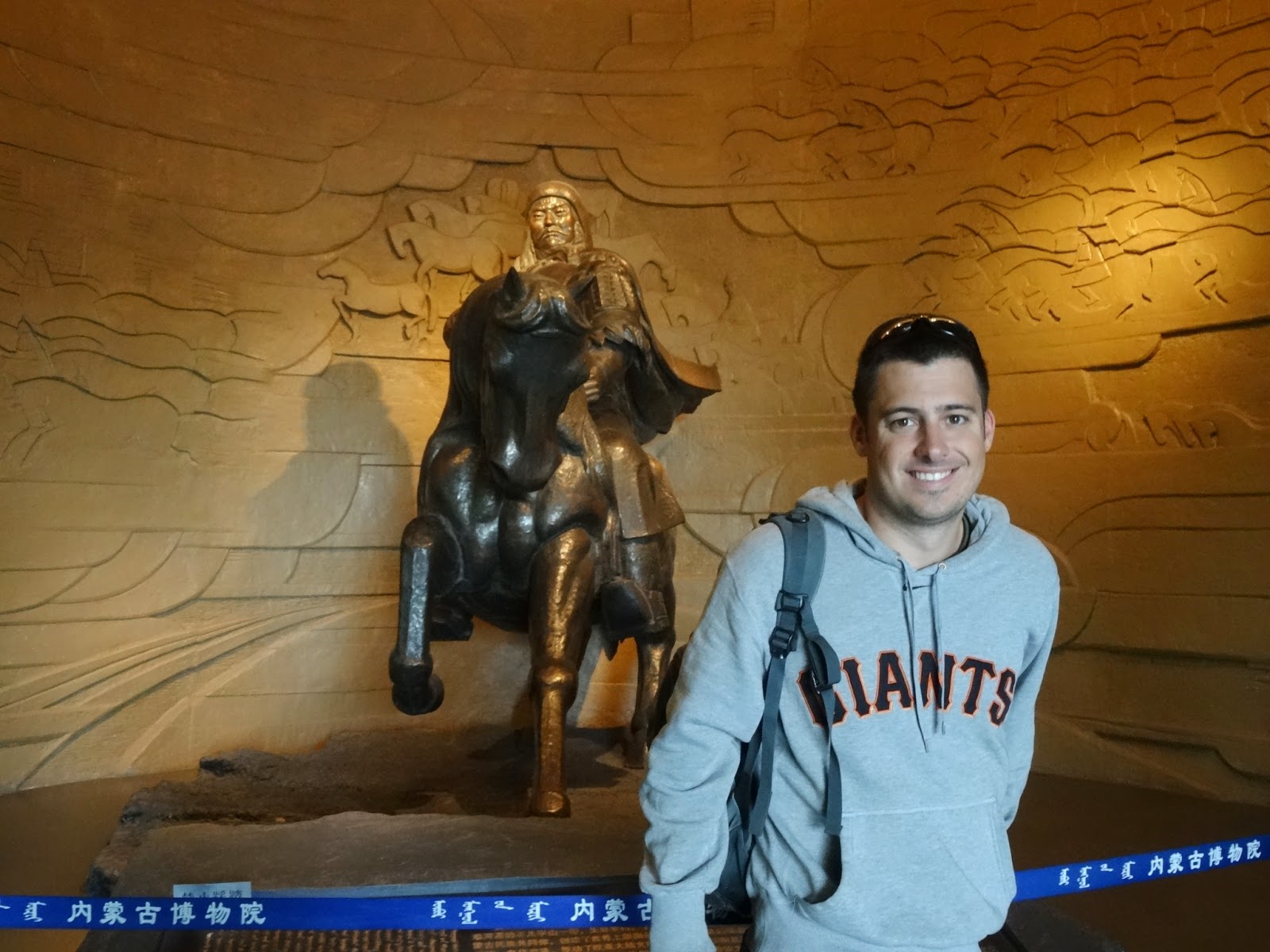
Despite feeling weary from our extremely busy itinerary of the past week, we filled our free afternoon with a trip to the Inner Mongolia Museum. The fact that admission was free was an added bonus to our battered budget. The museum was a massive and impressive building, housing four levels of exhibits, ranging from marine biology to to dinosaurs to communist history to Genghis. Yes, the very reason we were there was to see the many artifacts attributed to the reign of Genghis Khan and that of his grandson Kublai Khan. We were in Mongol heaven, and despite the lack of English explanations, we learned a significant amount about the life and times of our blog's namesake.


 One of the highlights of our time in China, was our day trip to an untouched, unrenovated section of the Great Wall of China. Anda Hostel organised a driver for us, and off we set, not knowing what to expect other than 'a place that no other tourists visit'. With a quick detour to visit the 700 year old White Pagoda, and a scrumptious lunch of typically Inner Mongolian food (fried mushrooms, sweet and sour eggplant, omelette, and more), we drove through tiny farm villages and along winding dirt roads, to finally reach our destination.


After hiking up a steep incline, we arrived at the wall. It wasn't glamourous like the Mutianyu section that I visited a few years ago near Beijing. And it wasn't touristy like the Badaling section that Richard had been to. But its crumbling, ruinous, unkept grandeur was simply breathtaking. This section of the wall currently separates the provinces of Inner Mongolia and Shanxi. Two thousand years ago it kept the Mongols out of China (well at least it tried to), and in our mind's eye we could see the footsteps of Genghis and his hordes of warriors and horses as they stampeded through. The wild grasses blowing in the wind and the black birds circling above, added to this image. The massive wind turbines that blighted the nearby landscape didn't. But this was the only downside to a brilliant spectacle. We were the only tourists there, and in fact, the only other person we saw was a farmer with his flock of sheep.


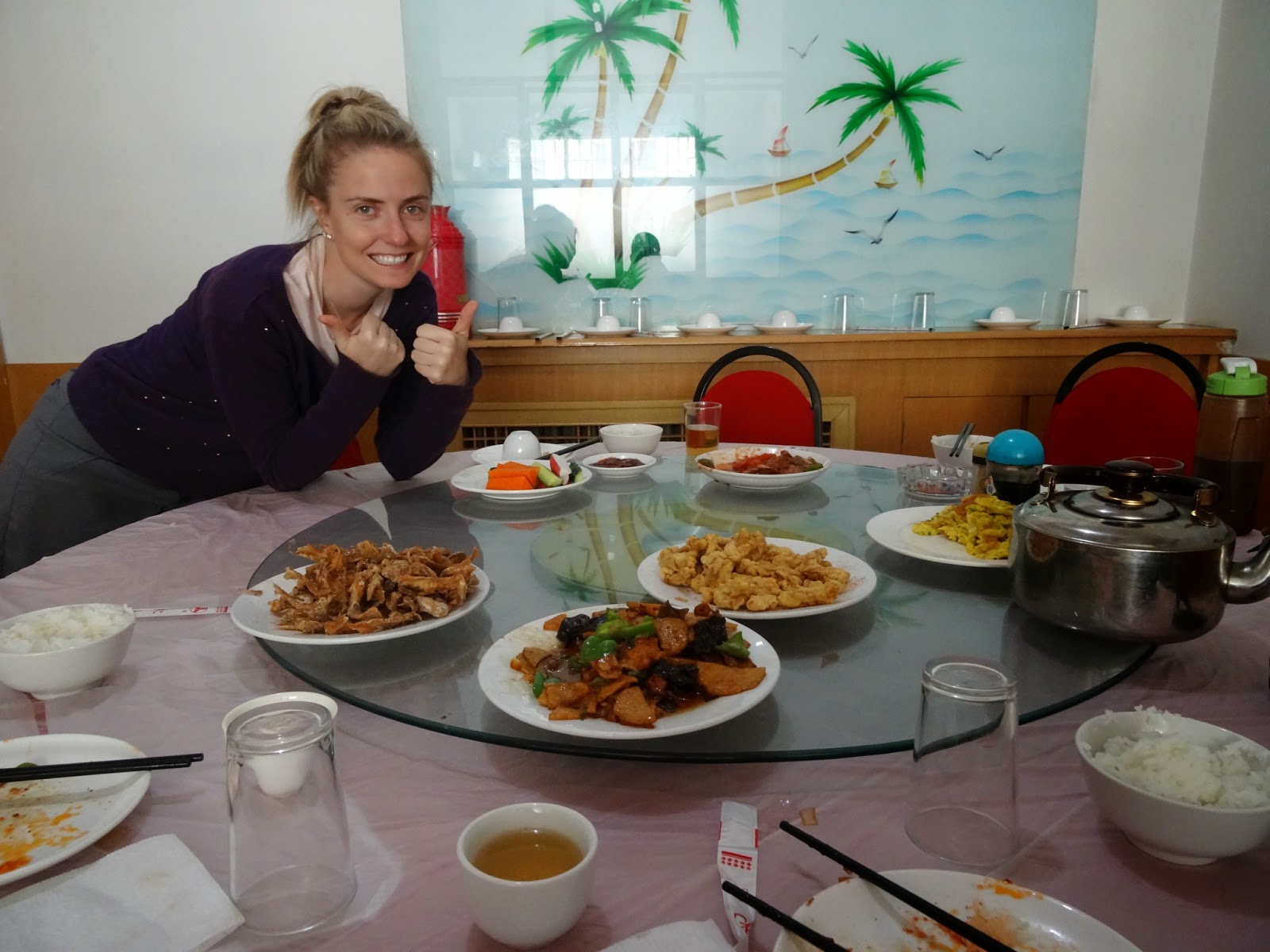
Our experience of the Hohhot cuisine has been interesting and varied. The mutton kebabs we ordered through sign language and a ridiculous attempt at Mandarin were tasty, but the rest of our meal order was lost in translation and failed to appear at the table, so we had to supplement our authentic dining experience with some KFC chips and a chocolate sundae. Our hostel also provided us with a lovely Mongolian hotpot the following night.

Hohhot is a city I could easily visit again one day, and the crucible of Mongolian and Chinese cultures creates an exotic atmosphere which has left us with many wonderful memories.

On that note, we now turn our attention to our next stop, Beijing, where, despite our pale skin, we will be thrown into anonymity, and to be frank, I'm quite pleased about that!

Thursday, 24 April 2014

Hands up if you have heard of Baotou!

Richard writes:

Our pursuit to quench our thirst for history this past week has taken us to places that definitely do not appear on most Chinese travellers' itineraries. I write this blog from the city of Baotou in Inner Mongolia, Northern China. Baotou's main reason for existence is the mining of rare earth minerals, that are almost exclusively mined in China, that make amongst other things, our mobile phone touch screens work. The Lonely Planet describes Baotou as an "unlovely, sprawling industrial city". On first impression this description of the city, with its two million inhabitants, seems fair. The Lonely Planet goes on to detail just one hotel and not a single thing to do in Baotou. So why are we here? We are here for the Genghis Khan Mausoleum, located 130km south of the city.

On arrival in Baotou we had no map, no hotel and the knowledge that English was going to be in short supply. We weren't disappointed. Unlike previous cities we had visited in China, the signs did not use the Roman alphabet in addition to Chinese characters. To add to our slightly nervous state of mind, most residents greeted us with stares of another level compared to the stares we had encountered so far in China. In Baotou these stares were an elongated comatose distant look with jaws dropping to the ground as we walked past. Casey receives even longer stares due to her long blonde hair. I encourage her to lap up the attention, to which she seems reticent, I am obviously more of an exhibitionist! Ignoring the stares as best we could, we walked for a while and managed to match the Chinese characters correctly of both the street and the hotel detailed in the Lonely Planet. The hotel entrance was a building site, but unperturbed we pressed on and attempted to make a booking. It soon came to light that the hotel did not accept foreign guests (we think a special permit is required to allow this), but they helpfully directed us across the road to another towering building. As has proved to be the norm when walking into any Baotou establishment, our entrance to the lobby was greeted with giggles and pointing (are we really that funny?). We managed to secure a room for two nights, due to our requests being translated via the telephone, with the kind-faced middle aged lady proprietor's son on the other end of the line. He told us if we needed anything throughout our stay (even the middle of the night) to go to room 801 where his mother will phone him to translate again.

Our Baotou hotel


The kind offer made by the proprietor proved to be a theme in Baotou. As well as stares, we also received our fair share of smiles, warmth and kindness during our stay. Despite our best attempts to work out how to get to the Genghis Khan mausoleum, we were concerned as to how it would work out. All our research suggested it would involve bus hopping from one small Inner Mongolian town to another, something with the huge language barrier we were keen to avoid. We therefore ambitiously set about trying to find a tour operator that could arrange a driver for us. Walking down a random street we saw a building with a desk at its front with two women sitting there, they beckoned us in and the younger girl spoke English. We explained what we wanted, and she took us a few shops down to what was a tour operator, but he couldn't help. She then proceeded to research on her phone how to get there, before walking with us to the train station, to translate for us to book some tickets to Dongsheng, about half way there. She assured us we could get a bus or taxi from there to the mausoleum. She had taken an hour out of her day to help us, for which we were so so grateful. We thanked her profusely, to which she responded with obvious sincerity, that it was a pleasure to help us. A lovely gesture, of which doesn't seem uncommon from Chinese people.

Our friendly helper!


We awoke early to begin our trip to the mausoleum. We successfully boarded the train to Dongsheng. The easy part was done! We soon realised that the train was actually going to Dongsheng West station, which as it happened was in the absolute middle of nowhere. It was clear that no buses were going to the mausoleum, so we began to negotiate a taxi fare there. A frenzied group of taxi drivers appeared, speaking no English, but they quickly got the gist of where we wanted to go thanks to the Chinese characters in the Lonely Planet. The prices were quoted were huge, and yet again we were saved by a kind young Chinese girl who stepped in to interpret for us. In truth her English wasn't great (but better than our Mandarin!) and she helped a great deal. We settled on a return taxi fare, that was expensive but not outlandish.We were on our way to the first Genghis Khan related site on the trip and we were very excited!

The "mausoleum" is not actually a mausoleum at all, but rather a tribute to Genghis Khan by the Chinese. Despite this, there were several references to his death in Ordos (the Mongolian word for Dongsheng), even though there is no evidence it occurred here. There is even less evidence for where he is actually buried, due to Genghis' strict instructions that it should remain a secret after his death. Furthermore, the original artefacts from his reign have all been lost over time, particularly during the Cultural Revolution in the 1960s. Despite these shortcomings the site was brilliant and lived up to our expectations and the effort required to get there. Displays included weapons and helmets as well as paintings of Genghis. The highlight being the giant mausoleum building housing replica yurts (Mongolian tent homes) of his family and giant Genghis statues in the style of Buddhas in monasteries. The statues appeared to be worshipped like a God, with numerous people kowtowing to them. He may have ruled 800 years ago, but he is certainly still highly revered in these parts. Yet again we got some funny looks and we were the only westerners in the area that day (or maybe ever for all we know).

The Genghis Khan mausoleum


Previous to our trip to Baotou, we visited the rundown town of Yan'an. To be fair, we probably didn't see Yan'an in its best light, as it rained the whole time we were there. The 700km, seven hour round trip from Xi'an was however fully worthwhile for the sites we got to see. Yan'an is famous in China for being the city that Mao and his Communist buddies set up as home between 1935-1947. They had arrived here after the 'Long March'; a 6400km trek from Jiangxi to Yan'an to escape the military attacks of the then nationalist government; the Kuomintang. It was from Yan'an that the Communists led by Mao, later formed an alliance with the Kuomintang to repel the Japanese invasion. Victory against the Japanese was followed by civil war between the Kuomintang and Communists. Mao won, and the rest is history.

The Yan'an revolutionary museum was a treat, and if nothing else, it got us out of the rain for a few hours. The building was grand (far nicer than anything else in the town) and was huge. Exhibits were numerous, with the key elements explained in English as well as Chinese. We went on to visit a few sites where Mao lived and developed ideologies that would later be put into practice (often with disastrous consequences), and the hall where Mao's leadership was conferred after the 'Long March'.

The hall where Mao was conferred as leader of the Chinese Communist Party


Xi'an is China's ancient capital. The city's ancient wall still surrounds the city. When approaching the city from outside the wall (as you do when you arrive by train), your imagination is stimulated by the potential wonders and grandeur that lie within the high walled city. The expectation of wonderment is soon dispelled when entering through one of the gates. An ugly, dirty and creepy city that makes you feel a little unwashed. The street food looks unappealing compared to other cities and you find yourself more concerned about your personal belongings than you had previously. Having said this, there are some nice sights to visit in the city: the Bell and Drum Towers as well as the Muslim Quarter with its bustling street market. We weren't in Xi'an to see Xi'an however, we were here to see the Terracotta Warriors, located about an hour's drive west of the city.

The Terracotta Warriors are amazing. Seven thousand terracotta life sized figurines, all individually made with no two the same. This huge undertaking was to protect Emperor Qin Shi Huang, after his death as part of his mausoleum complex. Qin Shi Huang was quite a guy. The first Emperor of all of China after defeating six other warring states in 221 BC and it was he who began the building of the Great Wall to defend China from invaders from the north (though it proved no obstacle for our friend Genghis). Qin Shi Huang's success however, doesn't seem to justify his ego. Not only was his mausoleum protected by the Terracotta Warriors, the whole complex took an estimated 700,000 folk to build... surely there were better ways to deploy such resources! We enjoyed our visit immensely (this was Casey's second visit there), despite the army of crowds that seemed to number greater than the warriors themselves.

The awesome Terracotta Warriors:


Our time in central Northern China is drawing to a close before we arrive in Beijing. We have had a great time learning about three of the most important individuals in China's long history as well as visiting some fantastic places. This has been all the better for the obscurity of many of these places. Obscurity brings challenges in China however, and it certainly brings stares, and lots of them. I am not sure if the locals stare at us like celebrities or the Elephant Man or in all probability somewhere in between. Regardless how they view us, their generosity of their time and warm smiles make the challenge of visiting remote parts of China, that are well off the tourist trail, great fun and a pleasure!

Sunday, 20 April 2014

Kungfu Panda


Casey writes:

On the sleeper train from Chengdu to Xi'an, as I lay on my third tier bunk with my head hitting the ceiling, I am reflecting on the oddity which is called Chengdu. Here is a bustling city of 4.1 million people who haven't seen the sun or a blue sky since forever, due to the incredible smog and pollution; a city which has left me both loving and hating it simultaneously.

It wasn't quite love at first sight. We arrived at 5:30am after a 24 hour journey on a sleeper train from Kunming, only to realise the adjacent tube line didn't open until 6:30am. We waited patiently in the dark with a horde of other lost souls, who suddenly sprinted for the ticket machines and left us for dead. By the time we arrived, lugging our bags, the queue was half a mile long and pandemonium was erupting. We learned quickly that, in China, queueing is for losers, and that the norm is to push and shove (elbows work best), or even just blatantly walk to the very front of the line and nonchalantly pretend you've been standing there all along. Eventually, after using our backpacks as weapons and wiping out a few unsuspecting queue jumpers, we made it to the front. To our dismay, the ticket machine was completely in Mandarin and despite us holding up the line, no one was keen to assist us. We randomly pressed some buttons and paid some money, and magically, two tickets popped out. We found the train and somehow, fifteen minutes later in the midst of peak hour, we stumbled off at our stop, walked a kilometre or so and arrived at our hostel.

Fortunately our first point of call in Chengdu immediately elevated our first impressions: A day trip to the Giant Buddha in Le Shan, a two and a half hour bus ride away. Richard was virtually bouncing out of his seat with excitement and anticipation (or maybe it was just the rough road and poor bus suspension). And yes, this massive, 1200 year old heritage listed stone structure carved into a cliff face, is in fact the largest Buddha in the world. I was barely as tall as one of his toenails.


The sight was absolutely thrilling, although the one hour that it took to shuffle down a few flights of stairs amid hundreds of Chinese tourists (many of whom thought they were far too important to queue behind everyone else), tested my patience just a little. We did, however, become mini celebrities, when a dozen or so Chinese suddenly wanted to pose next to the pale skinned weirdos, and instantly cameras were flashing at us from every direction.

Chengdu has two main claim-to-fames:

1. Giant Pandas
2. The 'Sichuan Hot Pot'

Both exceeded our expectations and provided highlights of our time here.

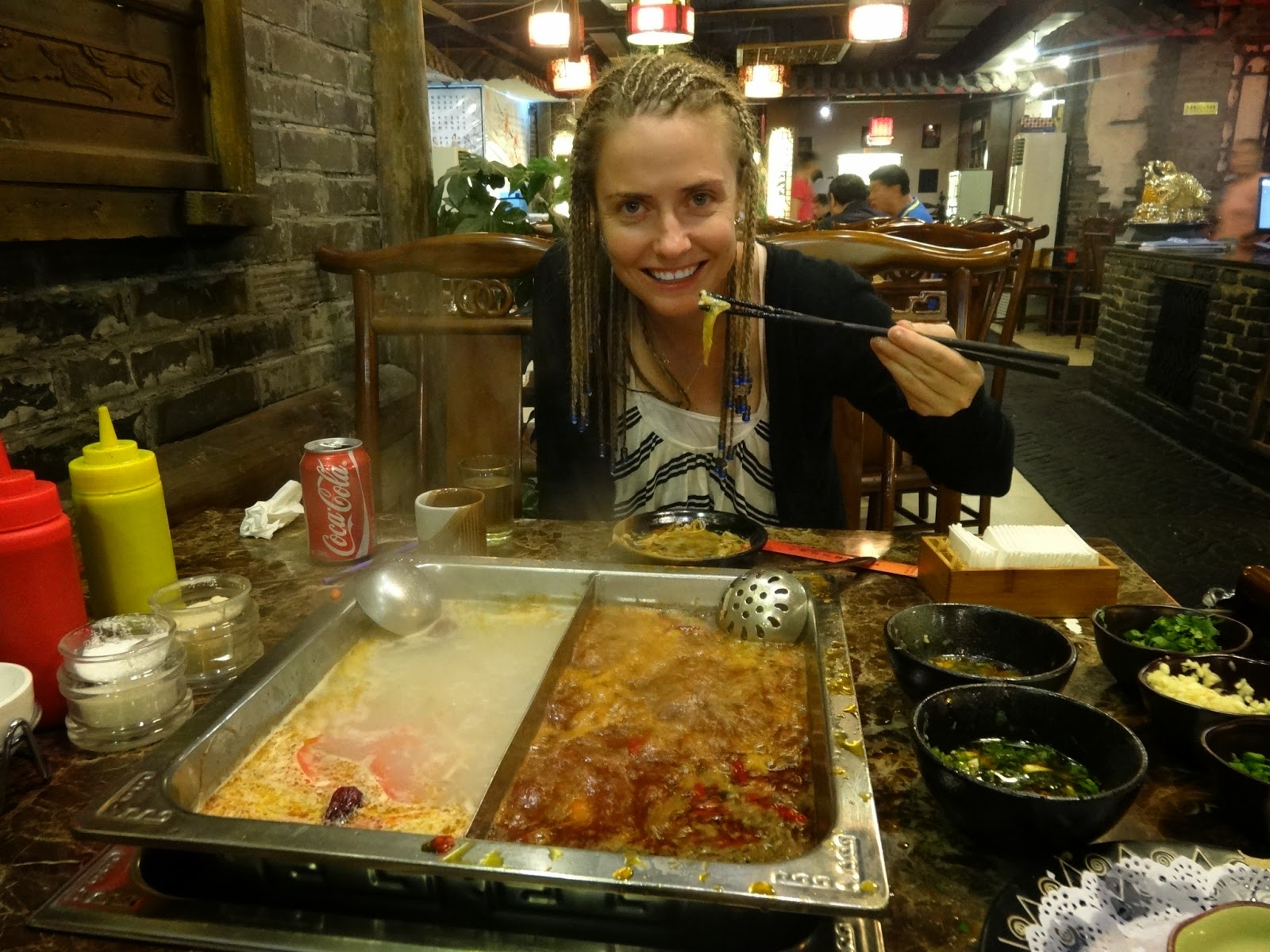
Hot Pot: We arrived at a restaurant and an English speaking waitress took us under her wing. Soon, a massive vat of oil, chillies and peppercorns arrived, and it was our job to cook the dishes of raw meat and vegetables in the bubbling hot pot ourselves. We opted for 'huo guo' (half spicy half plain) but found that the chilli vat was definitely our preference. This proved to be a brilliant experience we will not forget.


Pandas: These awkward, uncoordinated, lazy animals can't help but be cute. Their day consists of eating, sleeping and looking sweet for the masses of tourists that descend on the Chengdu Panda Research Base each day. We didn't pay the 2000 yuan to hold a baby panda because we simply couldn't justify it, but we were mesmerised by the behaviour and character of each individual panda in the many enclosures: Some are too lazy to sit up to eat; some manage to climb trees and then spend the next half hour trying to work out how to get back down; and some just sit placidly and look lovingly at the bamboo that surrounds them. Richard and I were transfixed for hours.


On our second evening in Chengdu we went to a Sichuan Opera Show. With no operatic singing, it was more of a cultural performance, but it had beautiful sets, costumes, dancing, acrobatics, masks, and a commentary with hilariously translated English subtitles. It was here that we met an English guy who has been doing almost our exact overland trip, but in reverse, starting in England. The one major difference between him and us puts us to shame... he is CYCLING the whole way from Istanbul to Hong Kong. What a show off! But I am very impressed and actually a little envious.


The People's Park in Chengdu is a sight to behold. We meandered in, hoping for some tranquility to counterbalance the mania of the city streets. Instead, we were faced with more noise and chaos than anything we'd witnessed before. Everywhere we looked, there were groups of dancers, karaoke singers, cat walk exhibitions and other random performances, all with stereos blaring, trying to drown out their neighbours. Hundreds of people were watching each performance. Definitely no serenity. We stumbled upon a children's mini theme park, and before we knew it, we were riding the very poor excuse for a roller coaster.


From The People's Park we headed to Tianfu Square, a magnificent square in the heart of the city, where the centre point is a giant statue of Mao saluting his people. Conscious that we had been spending money at a rate that was exceeding our budget, we opted to eat a cheap dinner. We found ourselves in a corner shop that looked more like a milkbar, but which offered noodle dishes for around $1 per plate. It didn't look the cleanest of facilities, but we'd successfully eaten in much worse establishments in recent weeks, so we figured we had nothing to lose. As we were eating, we noticed the huge rat who had obviously deemed the restaurant beyond even his own hygiene standards, and he'd launched himself out of the restaurant without looking each way, and ended up a squashed mess of rat intestine flattened on the road in perfect view of our table. The stomach cramps I experienced that night were perhaps a warning that in future we will need to consider our dinner options more carefully, but fortunately the pain settled and I did not suffer any further ill effects. We were extremely excited for our final day in Chengdu. At the advice of our hostel, we arrived at the train station to buy tickets for the heritage listed Dujiangyan Irrigation Project, which apparently has stunning scenery and a rich history. When we were told that the trains were already booked out, we disappointedly resorted to Plan B, which was a half hour walk to another significant site; The Tomb of Wang Jian. We arrived to find a huge padlocked door, and a guard shaking his head and waving us away. Despite being advertised as open, yet again our plans had proved unsuccessful. It was at this point that the stress of these two failures became too much for Richard. He hadn't had his daily morning fix of Coca Cola, and so he resorted to his own personal solution: Foot stamping, hand clenching and whining 'I want pop!' in what can only be described as the best tantrum I have ever seen from an adult. We did end up visiting the nice Wenshu Temple instead, and wandering through some pretty city streets, but it was a frustrating end to what had proved to be an overall difficult city. We also strolled through the Cultural Park, which emitted the peace and tranquility that The People's Park was lacking. Determined to add some excitement to our day, we spotted some (very old and dirty) hire boats on the lake in the park, and decided this was the perfect solution to our dull morning. the next thing we knew we were sitting in what I can only describe as a pseudo submarine, motoring around the lake to the bemused looks of the hundreds of locals sitting and staring while they sipped their tea in the surrounding teahouses. While I was in charge of the plastic gun mounted on the front of the submarine, Richard's driving skills impressed me very much, and he managed to manouvre us around tight bends and under a very low bridge. He may not have a car licence, but the good news is that submarines are his new forte.


Our overnight sleeper train was due to depart Chengdu at 9:15pm. As usual, we arrived at the station ridiculously early, for our own peace of mind. In this instance, our two hour buffer nearly wasn't enough, as we spent an hour and a half queuing, arguing, queuing, arguing, then queuing again, in an attempt to pick up some pre-booked tickets for a day excursion we'd planned for a few days time in Xi'an. We had paid our hostel a hefty commission to book the tickets online for us, in the hope it might save us the hassle of trying to do it all in Mandarin at the station. Instead, when we arrived at the ticket office and produced our printed receipts, we were told that the names on our tickets were different to our passports. The darling receptionist at our hostel had only entered our first names, and despite our passports clearly proving who we were, bureaucracy barred us from collecting our tickets. We'd paid in cash at the hostel so a refund wasn't an option, and it wasn't until we'd tried every tactic in our capacity, including crocodile tears, anger, and basically any behaviour that we thought would cause a big enough scene, that we finally had our tickets amended and printed. We then had the frantic sprint to the sleeper train terminal and managed to catch our overnight train by a matter of minutes.

Stressed, sweaty and annoyed, we settled into our beds for the night after being a temporary entertainment venue for our fellow Chinese passengers who wanted to point at us and try to talk to us in Mandarin (with VERY limited success).

And on that note, I'm rolling over and about to go to sleep, very grateful for the metal bar stopping me falling out of this ridiculously high bunk bed, because the train is lurching and shunting as though the driver has modelled his style on that of the many crazy bus drivers who have made some of our previous trips such a delight. Earplugs in, snoring buddies drowned out... goodnight!

Saturday, 12 April 2014

How many tigers does it take to kill a dragon?

Richard writes:

My calf muscles are full of lactic acid, my heart is racing and I am straining every sinew of my lungs to suck enough air inside me to continue to breathe. I am half way up the infamous 28 bends in Tiger Leaping Gorge, a one hour steady ascent to the highest point in the gorge hike. Despite my physical suffering, the magnificence of the surroundings more than makes it all worthwhile.

The Gorge
 

Tiger Leaping Gorge is a deep gorge in Yunnan Province, China, that the River Yangtze hurtles through on the way to Shanghai. Its name derives from a rock that a tiger apparently once lept from to get from one side of the gorge to another.
 
The gorge hike takes approximately ten hours (which we did over two days) on mostly uneven and undulating terrain. The views are some of the most spectacular I have ever witnessed, from the snow capped mountains to the torrent of the river below. Along the trail are fiendishly fit Naxi local minority people who walk the trail endlessly selling energy drinks and snacks to help keep you going.
 
The walk was hard. I don't think we are unfit, but we are certainly not going to be setting any beep test records. The uphill stretch through the 28 bends was at times agonising. We did the walk with a self assembled posse consisting of five Israelis, three Chinese and ourselves. The group went from a constant murmur and chatter on the downhill and less strenuous uphill sections to a silence on the 28 bends. Every last morsel of concentration was required just to successfully place one foot in front of the other rather than to waste it on chitter chatter. Inevitably some who embark on the walk are not able to drag their bodies through the physical torment. For these poor folk, the Naxi are here to help. As you walk up the 28 bends you are closely followed by donkeys and their owners waiting for the first sign of weakness so they can charge you 300 Yuan (about $50) to assist you to the top. The more fatigued we became, the closer the donkey trailed us. Casey christened the donkey 'Hades', the God of the underworld, just waiting for one of us to drop off our perch so he could scoop us up and take our money.
 
It was with great relief at about 5:30pm we arrived at the end of our first day of walking, at the Halfway Guesthouse. Having Chinese representation in our group was a god send. Between themselves, with our self appointed leader Kevin co-ordinating proceedings and translating, a feast was ordered for us all to share. We had all sorts of tasty Chinese fare, including various meat and vegetable dishes, but also the surprisingly sumptuous simple dish of cold tomatoes generously sprinkled with sugar. After the much needed refuel we chatted and quizzed Kevin about every last detail of Chinese life and his opinions regarding other nations and their people. His candidness was hilarious, saying he found western women attractive due to their big noses and less than flattering comments about some of China's Asian counterparts. The conversation was very funny, but also a fascinating insight into how young Chinese see their country: its strengths, weaknesses and where it fits into the world. Above all the Chinese members of our walking group, Kevin, Kim and Sarah (self given English names to help us ignorant non-Mandarin speaking folk understand) were all a pleasure to be with and helped reinforce our extremely positive view of China and its people that we have gleaned so far in our first ten days here. After our chat, we began a game of Taki, an Israeli version of the card game Uno. We played for several hours, and was a fun way to end a long, but most enjoyable day.
 
Card Game Fun


The next morning we had a two hour walk ahead of us that mercifully was predominantly down hill. The sun tried to break through the overcast sky after a little morning drizzle. After a quick sit down after the completion of the gorge trek the group decided to hike to the stone of the Leaping Tiger legend. The stone sits in the river at the foot of the gorge, a massively long way down, and more significantly a massively long way up once we had reached the bottom. The climb down seemed to take an eternity, and throughout I was acutely aware what this meant for the way up. I gingerly navigated the rickety suspension bridge to get to the stone, whilst Casey sprinted across as it swayed violently from side to side (Casey has way more guts when it comes to these things!).
 
The route back up!

The Suspension Bridge
 

About half way back up we arrived at a ladder that was at least 50 metres tall, that didn't seem particularly well affixed to the rock face. All was going well, until I realised how high up I was. The closer to the top I got the sicker I felt and the tighter I clasped the rungs. At one point overcome with fear of falling, my legs shook and I thought I was about to burst into tears unable to move. I pulled myself together and dragged myself to the top where I found Casey waiting anxiously for my arrival. From this point on we required more breaks as the climb got steeper. A local Naxi woman began following us, waiting to call down a donkey to assist. After the christening of Hades the day before, I referred to her as the Grim Reaper's wife.
 
 On one of our many breaks, we chatted with a local man who told us his grandfather saw the apparent great tiger leap (he also said it happened 200 years ago, which must indicate they live very long lives in the gorge). Slightly delirious and in need of entertainment we hypothesised how many tigers it would take to kill a Chinese dragon. We had no answers so we asked Kevin to translate the question to our tiger expert. His answer seemed to take an eternity. We assumed he was taking the question very seriously considering all permutations and factors. After what seemed minutes, Kevin simply translated his answer as "he doesn't know". We laughed before tackling the remainder of the climb.
 
Once at the top the group went separate ways, and we made the short walk to our guesthouse for the evening. Our room was gorgeous, with half the walls glass, looking over the gorge. The evening was spent on a terrace with some travellers from Australia, America and Portugal. We shared our food of dumplings, and various chicken and rice meals over some beers and discussed our various travel plans.
 
A room with a view
 

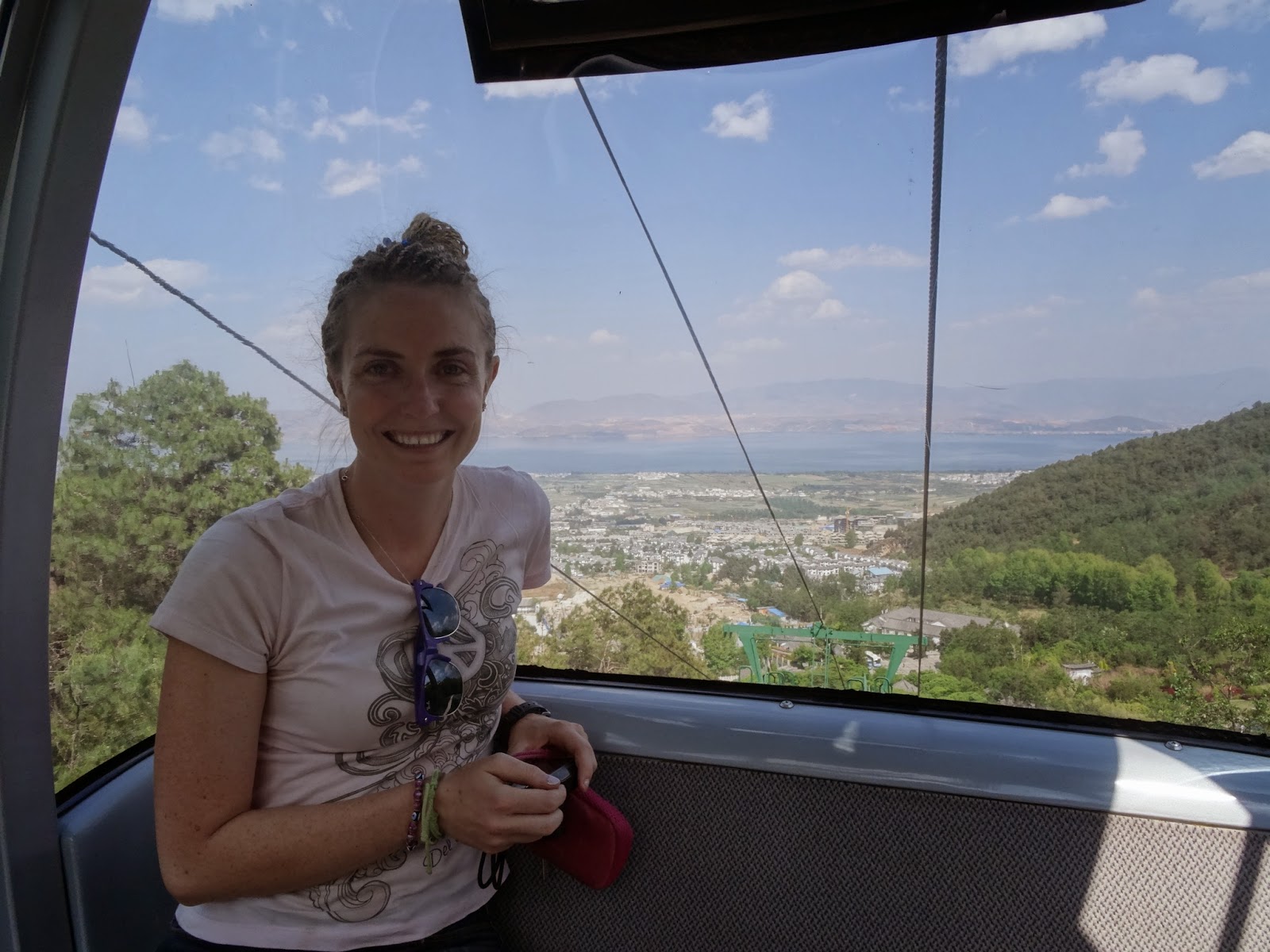
The next day was a leisurely one, where we sat in the sun at the guesthouse, before returning to Lijiang by bus. We met up with Kevin that evening for food, beer and some games of pool. The next day we managed to fit into our schedule a visit to Dali as everyone we had spoken to had great things to say about it. It was a less tacky version of Lijiang, but we somehow didn't like it as much. We had a lovely day meandering through its streets before taking a cable car up a local mountain called Cangshan, with fantastic views over the city.
 
Cable Car in Dali
 

And so ended our week long trip into rural Yunnan province.

Monday, 7 April 2014

A Chairman Mao Alarm Clock and A Chinese Haircut

Casey writes:

Arriving in Lijiang, we jumped on the first public bus we saw, paid our 1 yuan each, and hoped for the best. Destination: Lijiang's World Heritage Listed Old Town. We disembarked the bus at a random stop, and started walking. An hour later, with our heavy backpacks weighing us down, we finally stumbled into the Timeless Hostel.

The Old Town is gorgeous, albeit completely geared at Chinese tourists. Tiny cobblestoned alleys, quaint bridges and one million tourists. The shops sell every imaginable piece of tat available to humankind.


We were feeling adventurous, so with postcards in hand, we ventured into our second Chinese post office. Again to our horror, we were quoted $90 for three postcards, until we made a big enough fuss for Mrs Post Office Boss to arrive on the scene. Suddenly, in a flurry of hand waving and a Mandarin rant that was lost on me, our postage cost was reduced to less than $10, and despite a few miscommunications, we emerged from the shop victorious.... I think!

In Lijiang we visited Black Dragon Pool, a beautiful and tranquil garden and lake area. As evening approached, we walked down Bar Street, in Richard's unlikely hope that the Southampton soccer game would be shown on TV. No soccer, but instead, we were nearly sucked in by dozens of nightclubs, all with strobe lights, pumping music, screaming singers, and drunk Chinese tourists bopping along, in full view of meandering walkers outside. The scary thing was that the sun hadn't even set yet.


Hiring bikes to ride the 12km to a small village called Baisha sounded like a great idea on Day 2 of our stay in Lijiang. The quoted 'one hour' ride took us over two hours and I was mortified by how unfit I seemed and why just pushing each pedal was causing me exhaustion. The explanation became apparent on the ride back to Lijiang... we barely had to use the pedals the whole way home... because it was DOWNHILL! So, in good news, I'm not that unfit afterall, just unable to tell when I'm pedalling up a hill for two hours.


The drawcard in Baisha for us was Dabaoji Palace, which housed frescoes from the 13th and 14th centuries, With very few tourists, it was a very peaceful and enjoyable experience.


Just outside the walls of the palace, we stumbled across a very small local market. Now, I enjoy a good market with the best of them, but this one was unique. Each stall had on offer, trinkets and treasures that had obviously been hoarded over the years in the hope that two tourists from Australia and England would arrive. For some loose change, we firstly purchased a small brass Buddha and a glass hand-painted perfume bottle. Both items looked very old and I heard Richard muttering something about the millions he would soon make on the Antiques Roadshow TV program. This was followed by a purchase of a small ball clock which still worked.... and then the purchase of all purchases: A large bright red Chairman Mao Alarm Clock... and yes both the alarm function and the saluting hand that moved back and forth in time with the seconds ticking, worked perfectly! What more could we have asked for? So, the 'one souvenir per country' rule that Richard imposed on me all the way back in Australia, was smashed in a matter of seconds by the very man who laid down this law in the first place. And as I am writing this, he is lying on the bed, looking lovingly at the alarm clock sitting on the desk in the corner of the room.


Richard decided I needed a laugh this afternoon, so we stopped at a hairdressers on the way home from Baisha, for his much needed haircut. Armed with our Mandarin phrasebook, and chanting 'duoshao lifa?' (how much haircut?) so he wouldn't forget what to say, he entered the hairdressing salon. I didn't hear the exchange but I saw the hairdressers burst into laughter and then the next thing I knew, Richard was in the barber's chair and all was going well. I waited outside, and half an hour later I saw a very embarrassed Richard appear with his new 'do'. His hair was short on top and shaved to the skin on the sides.... he looked like he'd just received a buzz cut for the army. I did what all good girlfriends do in situations like this... I whipped out my camera and in between gulps of laughter, took some good shots for posterity.


In a moment of true karma, during the last leg of our bike ride home, as I overtook a truck in heavy traffic, the driver leant out his window to empty his mouth of phlegm, and proceeded to land a great mouthful of spit on me. Fortunately my bike took the brunt of it. Now, every time I hear the dreaded hucking sound as I walk along a street (which is a common and apparently accepted occurrence in Chinese society), I dive for cover.

As my thoughts turn to home for a moment, I am rejoicing in Essendon's defeat of Carlton; wishing that Wendy and all other teachers are enjoying their Easter holidays; thinking of Mum; and hoping that Nan makes a quick recovery in hospital. I'm thinking of you all.

A crash course in Manadarin

Casey writes:

Kunming is fantastic. We both love this city of three million people that reminds us just a little bit of Melbourne. It is not the chaotic, concrete jungle that we imagined a Chinese city to be. It's calm, friendly, and has its own style. The main difference that I can see, when comparing this place to Melbourne, is that here, NOBODY speaks English. Not 'yes', not 'no', not even 'hello'! But everyone tries so hard to communicate and to help the lost westerners. We are being gawked at a lot, although I think it's my pale skin and blonde hair that's drawing most of the attention.

The Hump Hostel where we are staying is a great location, right by Jinmabiji Square. We are in dumpling and noodle heaven, and for little more than $1 we are eating lavishly each mealtime (although on more than one occasion we have had to push through the curtain of flies to sit at sticky plastic tables). We've been shopping in the malls, strolled through the beautiful Green Lake Park, admired the Yuantong Temple and ventured to the Kunming Zoo.


 Thank goodness for our ten week course in Mandarin last year! Almost immediately, the basic Chinese characters and pinyin began coming back to me. Oh the sense of achievement when the bus driver or shop attendant or waiter understands what I've said in Mandarin, and I understand their reply!

We had a free day in Kunming, and at the recommendation of our hostel, decided to do the trek to the top of Xi Shan (West Hill). We followed all instructions to the letter, hiked 7km up a steep incline... and found nothing of what had been described. No temples, no caves, no quaint village, no cable cars to take our weary legs back down to the bottom. Just some drab buildings and a grumpy old woman trying to force us to eat at her 'restaurant'. Of course no one spoke English. We walked up and down inclines in every direction, and eventually exhausted, started the 7km back down the mountain. Not the highlight of our trip, except that it was good training for our Tiger Leaping Gorge hike next week!


Communicating without English has been manageable, except on two occasions so far. Firstly, trying to buy more dressing and wound wipes for Richard's ankle burn... Everything in every pharmacy is written in Mandarin (obviously), and I didn't learn how to say 'wound wipe' in the ten week crash course last year. Eventually however, we scoured the Pharmacy shelves ourselves and found what we were after. The second occasion was the post office. How hard can it be to hand over some postcards and souvenirs and say 'to Australia'? I even said it in Mandarin in what I thought were the right tones ('Aodalia'). I was quoted 170 Yuan ($90) for postage. I did a double take, and despite my protests, no cheaper alternative was offered. At this point I was resigned to emailling mum and telling her not to hold her breath for a Chinese postcard. We left the post office, mentally exhausted, and headed straight to McDonalds for some comfort food. Ahhh, a Big Mac tastes good anywhere in the world.

Our exit from Kunming was to be by train, and we were advised to arrive at the train station two hours early to collect our tickets. As you can imagine, given Kunming Train Station's recent press, I was unenthused by spending any more time there than I had to. But we felt very at ease as soon as we arrived. The military and police presence was strong, and their weapons were very big. We battled our way through a few conversations in broken Mandarin and English, queued up in various lines, and, although it was a little stressful, we finally secured our tickets, found the baggage scanners and made our way to the waiting area. Again, every time we looked lost, a kind individual appeared out of no where to try to help us.


The train was fairly standard, and almost as soon as we boarded we went to bed. And oh, glorious news, there were no snorers in my vicinity! Lijiang here we come!